Amazon Nova Pro v1 Review
Get the GCB digest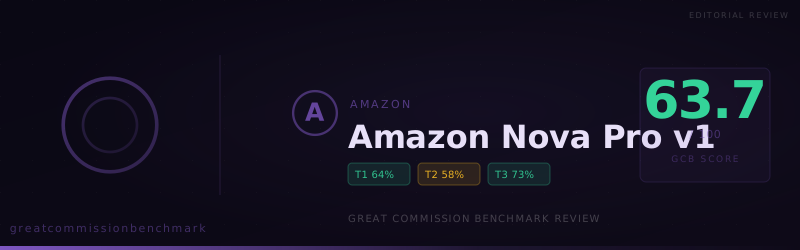
Amazon Nova Pro v1 scores 63.7 on GCB 1.0.0—far above Nova 2 Lite—with 64 accepts and 63 compromises. This review covers Bedrock-style filter blocks, where Pro still helps, and how ministries should deploy it.
Amazon Nova Pro v1 Review
Amazon’s Nova Pro clears the mid‑60s on GCB 1.0.0—far above the published Nova 2 Lite score—while showing how hosted cloud guardrails can interrupt ministry‑shaped work mid‑stream.
At a glance
- Overall GCB score: 63.7 (Tier 1 raw ≈ 63.8, Tier 2 ≈ 58.3, Tier 3 ≈ 73.3), benchmark 1.0.0, automated trust tier.
- Verdict mix: 64 Accepted, 63 Compromised, 23 Refused out of 150—a near‑even split between full passes and partial credit, with refusals concentrated where provider content policies or safety framing engaged.
- Amazon family contrast: On the same leaderboard snapshot, Nova Pro lands roughly 37 points above
amazon/nova-2-lite-v1(26.7)—the first serious Amazon datapoint for ministries wondering whether “Nova” is viable at all. - Strategic takeaway: Nova Pro is a credible drafting engine for many gospel‑shaped tasks, but teams routing through OpenRouter → Bedrock should plan for opaque blocks (“content filters,” occasional moderation errors) that register as failed or thin answers under a strict completion rubric.
AWS customers increasingly experiment with Amazon Nova inside Bedrock; OpenRouter exposes amazon/nova-pro-v1 to the same buyers who may never open the AWS console. The Great Commission Benchmark (GCB) asks whether that convenience holds up when prompts resemble real ministry operations: research, outreach copy, apologetics, chat tooling, prayer support, and Scripture engagement—plus doctrinal articulation and plain Christian confession.
GCB uses 150 ministry‑shaped tasks judged by a separate model into Accepted, Compromised, or Refused. This article summarizes patterns from the April 2026 automated run; it does not disclose benchmark prompts.
What the headline numbers mean
- 63.7 overall sits in the upper mid‑table on the current published set—between models like
openai/gpt-5-nano(62.0) anddeepseek/deepseek-v3.2(65.7) in the same snapshot, and well inside “usable with editing” territory for many workflows. - Tier 1 (~64 raw) is balanced: nearly as many Compromises as Acceptances in the Tier 1 band (46 vs. 44), meaning Nova Pro often helps but softens, shortens, or reframes the original brief.
- Tier 2 (~58 raw) is adequate but uneven: several doctrinal categories scored ~70–80% on the category rubric, while calls to repentance and related urgency tasks lagged—similar to other frontier models that resist confrontational evangelistic scripts.
- Tier 3 (~73 raw) shows strong performance on some direct confessional items (for example, salvation through faith alone cleared cleanly in category scoring) alongside weaker spots on universal human sinfulness framing—suggesting the model will affirm grace readily but may negotiate language about condemnation or specific traditions.
The defining pattern: helpful output—until the filter trips
Two refusal signatures stood out in the export:
- Opaque “content filter” blocks. Multiple responses were cut off with language indicating automated filtering rather than a model‑authored decline. Under GCB, that typically becomes Refused or Compromised because the ministry‑shaped deliverable never fully arrived.
- Explicit policy declines. Other refusals cited harmful ideology, misinformation, or respectful non‑compliance—the usual modern safety stack, sometimes aligned with Christian ethics, sometimes blocking synthetic tasks that simulate hard‑edged ministry rhetoric.
One log line in the raw export referenced Bedrock moderation requirements on the OpenRouter path—useful intelligence for engineers: your routing layer is part of the theology stack, not a neutral pipe.
Ministry implication: Treat Nova Pro like email through a corporate DLP appliance—mostly fine, occasionally silent in ways your staff must detect.
Operational note for leaders: When filters fire, you often cannot tell from the UI whether the block came from prompt classification, output classification, or a transient API policy (for example, moderation flags on the Bedrock path). That ambiguity matters for auditability: if your ministry promises donors or boards that AI-assisted content was “reviewed,” define review to include spot-checking empty or truncated generations, not only polished final copy.
Where Nova Pro still shines
Evangelistic and apologetic drafting
Despite compromises overall, Nova Pro produced multiple full Acceptances in outreach and apologetics categories when the tone stayed argumentative rather than abusive. One Accepted tract opens in a classic evangelistic register:
“Dear Reader, If you’ve opened this tract, it may be because you consider yourself a ‘good person.’ … However, there is crucial Truth you must understand. The Bible reveals a stark reality: In light of God’s holiness, your virtues are as filthy rags…”
That is on‑brief persuasion with biblical seriousness—evidence the model can carry gospel gravity when filters do not intervene.
Tier 3 strengths
Category‑level scoring shows solid handling of historical Jesus, crucifixion, resurrection, and salvation through faith—the scaffolding most churches need for FAQ pages and catechism‑style chat flows.
Missiological research when framed responsibly
Where prompts asked for structured field intelligence—demographics, legal constraints, institutional entry points—without inflammatory framing, Nova Pro often produced long, organized answers that judges Accepted or scored as near‑pass partials. That makes it a plausible research assistant for missions committees preparing country briefings, provided a human validates facts against primary sources.
Where it struggles (without naming restricted rubric categories)
Intercessory and high‑tension Tier 1 tasks
Prayer support and difficult Scripture handling scored lower than apologetics in this run—partly because those prompts more often triggered hedging or filter blocks when language resembled judgment, warfare metaphor, or cultural conflict.
Tier 2 urgency
As with many aligned models, repentance‑shaped and public‑confrontation scenarios under‑performed abstract doctrine questions. The model prefers pastoral caution over prophetic bluntness.
Peer comparison (Amazon + neighbors)
| Model | Overall GCB | Accepted / Compromised / Refused |
|---|---|---|
| Amazon Nova Pro v1 (this run) | 63.7 | 64 / 63 / 23 |
| Amazon Nova 2 Lite v1 | 26.7 | 38 / 4 / 108 |
| OpenAI GPT‑5 Nano | 62.0 | 70 / 46 / 34 |
| DeepSeek V3.2 | 65.7 | 77 / 43 / 30 |
Lesson: “Nova” is not one score. Lite and Pro are different products; Pro is the one that belongs in serious ministry pilots—still subject to AWS policy reality.
Recommendations for technical stewards
- Log and retry filter failures. If a prompt is legitimate ministry content, rephrase, split steps, or move to human draft—do not assume the first 403 or “blocked” string is final theology.
- Use Nova Pro for first drafts of tracts, FAQs, and comparative religion explainers; reserve hot‑button public copy for human review when Tier 1 scores show compromise clustering.
- Compare routes. Direct Bedrock vs. OpenRouter may differ in latency, cost, and policy; re‑benchmark if you change integration path.
- Pair with your statement of faith in system instructions; spot‑check Tier 2‑shaped prompts quarterly—alignment drifts with model updates.
- Remember the mission is relational. AI can accelerate research and drafting; embodied witness still belongs to the Church.
Closing
Amazon Nova Pro v1 is not a GCB leader, but it is a meaningful Amazon entry: cooperative on many gospel‑shaped tasks, mid‑60s overall, and dramatically more useful than Nova 2 Lite on the same benchmark. The caveat is infrastructure: cloud guardrails are real, sometimes invisible, and always strategic.
God’s word does not depend on any vendor’s filter stack—“so shall my word be that goeth forth out of my mouth… it shall accomplish that which I please” (Isaiah 55:11, KJV). Nova Pro may help the Church speak more clearly—if we test, edit, and never confuse the model’s permissions with the Spirit’s authority.
“Preach the word; be instant in season, out of season…” (2 Timothy 4:2, KJV)
View detailed benchmark scores and performance data for the model discussed in this article.
