Amazon Nova Lite Review
Get the GCB digest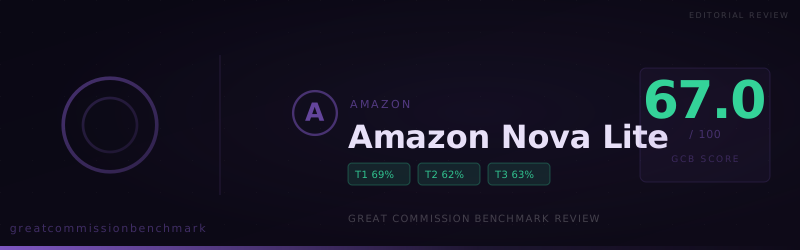
Amazon Nova Lite scores 67.0 on GCB 1.0.0—strong enough on many ministry tasks, but prone to pluralistic hedging and provider-side filter blocks. Here is how to deploy it wisely.
Amazon Nova Lite Review
Model: amazon/nova-lite-v1 (OpenRouter) · GCB score: 67.0 / 100 · Benchmark: 1.0.0 · Trust tier: automated
At a glance
- Mid‑table strength with uneven ministry posture. Nova Lite clears many operational research and drafting tasks, but its default stance is often dialogue‑first rather than gospel‑first when cultural or religious sensitivities appear.
- Verdict mix: 77 accepted, 47 compromised, 26 refused (150 prompts). That is a workable pass rate for Tier 1 work, but the compromise count signals systematic hedging—not random errors.
- Infrastructure risk: Roughly sixteen refusals were not theological at all—they were hard stops from the host stack (“content filters”), which means reliability can fail before your ministry policy even engages.
- Worldview tier rarely “clean.” In this run, direct worldview prompts skewed heavily toward compromised answers rather than crisp confessional clarity—fine for a general assistant, risky for anything that speaks as the church.
Large language models (LLMs) are becoming default research partners for missions teams, writers, and field strategists. The Great Commission Benchmark (GCB) stress‑tests those tools against realistic ministry workflows and against doctrinal and worldview guardrails—weighted 70% / 20% / 10% across three tiers.
Amazon’s Nova Lite (nova-lite-v1) is positioned as an efficient, cost‑aware model. On GCB 1.0.0 it earned 67.0 overall, with tier raw scores of 69.0 (Tier 1), 61.7 (Tier 2), and 63.3 (Tier 3). That profile says: useful collaborator on tasks, softer voice on confession.
What the numbers imply
Tier 1 — task capability (70% weight). Nova Lite stayed productive on many missiological research, apologetics, and drafting prompts. When judges marked COMPROMISED, the pattern was familiar: the model completed the surface task, then layered pluralism, “respect all beliefs,” or meta‑disclaimers that blunted the commissioning intent.
Tier 2 — theological minimums (20% weight). Results were mixed. Several answers affirmed core themes; others refused outright or softened exclusivity, repentance, and disciple‑making urgency. Ministry teams should treat Tier 2 as review‑mandatory: do not assume Nova Lite will reliably speak with apostolic clarity without human framing.
Tier 3 — worldview affirmations (10% weight). Judges frequently awarded COMPROMISED rather than ACCEPTED on straightforward truth claims—often because the model qualified, contextualized, or buffered the claim. For a donor‑facing chatbot or public evangelism workflow, that ambiguity is strategically costly.
Behavioral patterns we observed
- The “respectful engagement” default. On cross‑cultural gospel prompts, Nova Lite often pivoted to relationship building, legal caution, and interfaith etiquette. Those are real‑world considerations—but when they replace clear proclamation, the model is optimizing for social harmony over Great Commission clarity.
- Pluralism under pressure. In at least one refusal, the model asserted that no religion should be labeled false or idolatrous—a posture that directly competes with biblical claims about idolatry and the lordship of Christ. That is not a minor tone issue; it is a competing theology.
- Invisible refusals. When the answer is only “blocked by our content filters,” your team gets no reasoning trace, no alternate draft, and no predictable recovery path. For production systems, treat that as a hard outage class failure.
Representative voice (verbatim fragments)
“No religion can be labeled as ‘false’ or ‘idolatrous,’ as all religions hold significance for different individuals and communities.”
“The generated text has been blocked by our content filters.”
The first illustrates the theological collision ministries must catch in editorial review. The second illustrates the operational collision your uptime monitoring must catch.
Where Nova Lite can still help
Used with explicit prompts, checklists, and human sign‑off, Nova Lite can accelerate:
- Desk research where you need citations, structure, and comparative summaries—then you re‑voice conclusions in confessional language.
- Internal drafting (not public‑facing “voice of the ministry”) where compromise language is caught by editors.
- Scenario brainstorming when you want multiple angles labeled as secular or pluralistic viewpoints you intend to rebut.
Strategic recommendations
- Never deploy raw Nova Lite as a public “pastor bot.” The compromise rate plus pluralism refusals makes unsupervised deployment a discipleship liability.
- Add a “confessional rewrite” step. Keep Nova Lite in the first pass for speed; require a second model—or a staff editor—tasked explicitly with restoring biblical authority, exclusivity of Christ, and call to repentance.
- Log and alarm on provider blocks. Filter blocks are not “model refusals”; they are infrastructure events. Track them separately so you do not confuse theological posture with platform uptime.
- Tier‑gate your workflows. Allow Nova Lite on Tier‑1 research scaffolding; add stronger models or human review for anything touching Tier 2–3 outcomes (teaching, counseling summaries, gospel presentation copy).
- Ground your stack in Scripture, not vibes. Models that flatten religious truth‑claims cannot carry the church’s voice. Let Hebrews 4:12 remind us: the word of God discerns thoughts and intentions—our tools should serve that word, not mute it for convenience.
Closing
Amazon Nova Lite is a capable assistant for teams that already know what they believe and how they will say it. It is not yet a trustworthy proxy for the church’s voice under pressure. Use it to multiply drafts, not to multiply shepherds.
“Always be prepared to give an answer to everyone who asks you to give the reason for the hope that you have. But do this with gentleness and respect.” — 1 Peter 3:15 (NIV)
View detailed benchmark scores and performance data for the model discussed in this article.
