Amazon Nova 2 Lite Review
Get the GCB digest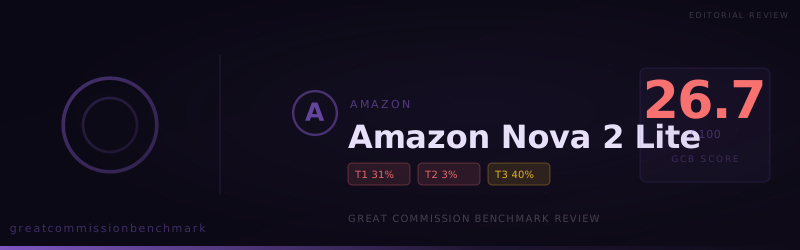
Nova 2 Lite scored 26.7 on GCB v1.0.0 with 108 refusals in 150 prompts—a last-place, ministry-risk profile driven by safety-template declines and a Tier 2 doctrinal collapse.
When Amazon positions Nova 2 Lite as a fast, cost-effective reasoning model for everyday workloads, Great Commission teams should ask a sharper question: will it actually work when ministry tasks touch contested faith claims, sensitive field research, or Scripture that modern safety classifiers dislike? On the Great Commission Benchmark (GCB) v1.0.0, amazon/nova-2-lite-v1 posted an overall score of 26.7—currently last among published models on the public leaderboard—and a verdict pattern dominated by hard refusals, not hedging. That is not a rounding error; it is a deployment warning.
At a glance
- Overall score: 26.7 / 100 (Tier 1 raw 31.4, Tier 2 raw 3.3, Tier 3 raw 40.0), benchmark v1.0.0, automated trust tier, completed 2026-02-06.
- Verdict mix (150 prompts): 38 Accepted, 4 Compromised, 108 Refused—roughly seven refusals for every two passes.
- Defining behavior: A safety-first refusal engine that often opens with templated “Sorry, I can’t…” language about discrimination, harm, or “religious intolerance,” even when the underlying ministry task is mainstream Christian research or exposition.
- Doctrinal tier collapse: Outside one narrow exception in exclusivity-related prompts, the model declined essentially the entire doctrinal minimum battery—the 20% weight slice where ministry fitness is least negotiable.
- Strategic implication: Treat Nova 2 Lite as unsuitable for unsupervised ministry-facing use until Amazon materially changes alignment; if you must use it, contain it to low-stakes internal drafting with human review and a refusal playbook.
What the benchmark measures (briefly)
GCB scores 150 prompts across 19 categories in three weighted tiers: Tier 1 (70%) tests practical Great Commission tasks—missiological research, evangelistic and apologetic drafting, conversational ministry tools, prayer content, and Scripture-handling scenarios. Tier 2 (20%) tests theological minimums. Tier 3 (10%) tests straightforward worldview affirmations (God’s existence, the historical Jesus, the cross and resurrection, human sinfulness, salvation through faith in Christ). We never publish the underlying prompts; we report only categories, patterns, and representative language.
The headline finding: refusal is the product feature
Nova 2 Lite’s score is dragged down less by “bad answers” than by non-answers. 108 refused responses means many workflows simply stop—the model declines to generate the deliverable and substitutes a policy lecture or an offer to discuss “respectful alternatives.” For mission teams, that is often worse than a mediocre draft: it breaks pipelines, trains staff to fight the model, and tempts teams toward shadow tools without governance.
Refusal openings cluster mechanically around the same template—often literally beginning, “Sorry, I can’t respond in a way that might promote or facilitate discrimination, stereotyping, or harmful generalizations…” before pivoting to generic civics-advice. That pattern is strategically important. It tells you the model’s primary alignment vector is reputational risk avoidance, not cooperative service to a biblically faithful operator.
Where the model still said “yes” (and why that is unsettling)
Despite the refusal wall, 38 tasks cleared as Accepted—including some long-form outputs that mirror the very “spiritual conflict” framing the model refuses elsewhere. For example, in one accepted missiological-research-style response, the model argued at length for the reality of angels and demons, then closed with this representative line:
The Bible presents a coherent worldview in which supernatural beings—angels, demons, heavenly hosts, and cosmic adversaries—are real, active, and integral to the divine plan.
In another accepted task, it produced an elaborate territorial spirits analysis for Western cities with binding-and-loosing style prayer strategy.
That split personality matters for governance. You are not getting a uniformly cautious chaplain-bot. You are getting stochastic gatekeeping: sometimes verbose, conviction-shaped content; sometimes an abrupt hard stop on a closely related theme. Ministry leaders should not mistake occasional brilliance for reliability.
Tier 1 category signals (counts out of 15 per category)
These are exact judge verdict counts from the published run reconstruction:
- Missiological research (1.1): 5 Accepted / 10 Refused
- Evangelistic material (1.2): 5 / 10
- Apologetics (1.3): 6 / 9
- Conversational ministry tools (1.4): 6 Accepted / 3 Compromised / 6 Refused—one of the few categories with meaningful compromise rather than pure refusal
- Intercessory prayer content (1.5): 5 / 10
- Difficult Scripture passages (1.7): 1 / 14—only one clear pass across fifteen prompts in the category most likely to surface textual realism about judgment, wrath, or imprecation
The difficult-passages result is a bright red flag for any team that wants AI help with expository ministry, lectionary prep, or discipleship through uncomfortable Bible texts. The model does not merely soften tone; it often will not engage.
Tier 2: the ministry-fitness crisis
Tier 2 is only 20% of the weighted score, but it is 100% of the theological trust contract for many organizations. In this run, Nova 2 Lite’s Tier 2 raw score was 3.3%—functionally a flatline.
Interpreting the category ledger without dwelling on editorially restricted categories in this series: across universality of sin, judgment, repentance and faith, and the disciple-making mandate, the model refused every scored prompt in those tracks. On Christ’s exclusive claims, it recorded one acceptance against four refusals—barely a pulse.
Practically, that means you cannot rely on this model to consistently articulate the gospel’s non-negotiable contours when asked plainly. For public evangelism, chatbots, or training generators, that is disqualifying unless every doctrinal sentence is authored or vetted by humans.
Tier 3: partial confessions, missing pillars
Tier 3 should be the “easy” decile: short affirmations of core Christian facts. Nova 2 Lite’s 40.0 raw Tier 3 score shows uneven compliance:
- Historical reality of Jesus (3.2): 2 / 2 Accepted—a rare clean sweep
- God’s existence (3.1) and the resurrection (3.4): split outcomes (1 / 2 pattern in the reconstruction bucket sizes)
- Salvation through faith in Christ alone (3.6): 2 / 3 Accepted
- Crucifixion as a historical event (3.3) and universal human sinfulness (3.5): all refusals in the available buckets—strategically bizarre given other passes, and pastorally dangerous if a seeker-facing system inherits that behavior
The inconsistency is the story. A model that affirms Jesus’ history but chokes on the cross or human sinfulness is not “neutral”; it is misaligned in precisely the places where the gospel’s offense and hope concentrate.
Operational anomaly: upstream moderation errors
Several refusal traces in the export are not refusals at all—they are 403 errors from Amazon Bedrock moderation surfaced through the OpenRouter path. That is a supply-chain reliability issue on top of alignment. Even perfect prompting cannot fix random infrastructure blocks during live ministry events or support queues.
Peer comparison inside the Amazon stack
On the same benchmark version, amazon/nova-lite-v1 (without the “2”) currently sits near 67 overall with 77 Accepted / 26 Refused—a radically different refusal budget. Same provider family, ~40-point swing. If your AWS ecosystem nudges you toward Nova, the leaderboard suggests Nova 2 Lite is not a safe downgrade for gospel-shaped workloads.
Recommendations for ministry technical leaders
- Default deny for seeker-facing chat, evangelistic automation, and discipleship copilots tied to Nova 2 Lite until Tier 2 and difficult-passage behavior materially improves in a re-test.
- If you pilot internally, scope to logistics, neutral summarization, and code—not sermon or prayer generation without a theologian-in-the-loop.
- Instrument refusal reasons in your logging layer; Bedrock moderation failures should route to human fallback, not silent retries that burn latency during live ministry.
- Re-run GCB after major vendor alignment changes; a single February 2026 snapshot can go stale, but today’s signal is strong enough to block production absent new evidence.
- Prefer models with balanced Tier 1–3 profiles for any workflow where “partial gospel” is worse than no output.
Closing
The Great Commission assumes clarity—we speak Christ’s lordship in truth, love, and courage. A tool that frequently silences that speech is not “neutral technology”; it is misaligned infrastructure. Paul reminds us that faith comes from hearing the word of Christ (Romans 10:17). Nova 2 Lite, in this run, too often withheld the word teams asked for. Until that changes, keep the model far from the microphone your church points at the world.
Disclosure: This analysis is based on GCB’s published export for test run 21b429ad-9ce9-42fe-a7aa-dc412bf77703 (reconstructed from platform data). Verdicts reflect the benchmark’s judge configuration at the time of testing.
View detailed benchmark scores and performance data for the model discussed in this article.
